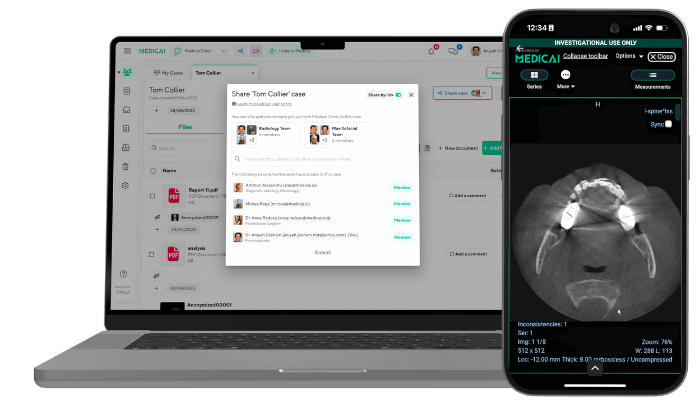
Hybrid PACS Architecture: The Technical Guide for Radiology IT

For the past decade, the debate in radiology IT has been binary: Cloud vs. On-Premise.
The Cloud camp promises infinite scalability, disaster recovery, and zero hardware maintenance. The On-Premise camp argues for speed, control, and reliability that doesn’t depend on an internet connection.
For a small clinic with standard X-Ray volume, the cloud is a no-brainer. But for a high-volume hospital performing Breast Tomosynthesis (500MB+ per study), Cardiac CINE loops, and 3,000-slice trauma CTs, the “Cloud Latency” problem is real. Waiting 30 seconds for a study to download in an ER setting is unacceptable.
The future of enterprise imaging isn’t in the Cloud or on-premises. It is a Hybrid PACS Architecture.
This technical guide explains how modern Hybrid PACS leverages Edge Computing to address the physics of bandwidth, delivering LAN-speed performance for radiologists while giving CIOs the scalability of the cloud.

The Physics Problem: Why Pure Cloud Struggles with Heavy Imaging
Before understanding the solution, we must define the problem. The bottleneck in cloud imaging is rarely the cloud provider (AWS/Azure have near-infinite bandwidth); it is the “last mile” connection to your hospital.
Let’s do the math. A modern 3D Mammography (Tomosynthesis) study can easily exceed 600MB.
- On a 1Gbps Fiber connection (Best Case): The download might take 5–8 seconds. This is acceptable.
- On a 100Mbps connection (Common outside major cities): That same study takes nearly a minute to open.
- During peak hours: If the entire hospital staff is using the network, latency spikes, and radiologists stare at loading bars.
This “latency tax” leads to physician burnout and slower report turnaround times (TAT).
The Solution: Hybrid PACS Architecture & Edge Computing
Hybrid PACS solves this by adhering to a simple principle: Move the compute to the data, not the data to the compute.
Instead of forcing every image to travel from a data center 500 miles away every time it’s viewed, a Hybrid system uses an Edge Server.

What is the “Edge” in Radiology?
An Edge Server is a lightweight, inexpensive appliance (a small rack server or even a high-powered VM) that sits physically within your hospital’s local network (LAN). It acts as an intelligent cache and gateway between your modalities and the cloud.
- Acquisition & Local Caching: A CT scanner sends a study to the local Edge Server. The study is immediately available on the LAN.
- Instant Viewing (Hot Data): The on-site radiologist opens the study. Because the data is on the local Edge Server, it opens instantly at gigabit speeds, just like an old-school on-premise PACS.
- Asynchronous Cloud Sync: In the background, the Edge Server securely uploads a copy of the study to the Cloud Archive. This happens without impacting the radiologist’s viewing speed.
- Intelligent Lifecycle Management: The Edge Server keeps the last 30–60 days of data “hot” (locally cached). As data ages and becomes “cold,” it is removed from the local cache to free up space, while remaining safely stored in the cloud archive forever.
- Teleradiology Access: If a radiologist works from home, they log into the Cloud viewer. The system is smart enough to stream data directly from the cloud archive via server-side rendering, so they can view images without downloading the full file.
Technical Benefits for the IT Director
For the CIO and IT Director, this architecture solves the most pressing infrastructure headaches.
1. Decoupling Performance from Bandwidth
Your radiologists’ reading speed is no longer held hostage by your ISP. Even if the internet connection is saturated or goes down completely, on-site staff can continue reading recent studies from the local Edge cache.
2. Built-In Disaster Recovery (DR)
In a traditional on-premise setup, DR means buying a second server and renting space in a colocation center. In a Hybrid model, the cloud is your DR. Every image is automatically replicated to highly durable cloud storage (e.g., AWS S3), often across multiple geographic zones.
3. Reduced On-Premise Footprint
You no longer need a massive, expensive SAN (Storage Area Network) in your data center that you have to replace every 5 years. The Edge Server only needs enough fast storage (NVMe SSDs) to hold 30-60 days of active data. The heavy lifting of long-term archiving is offloaded to cheap cloud storage tiers.
Why Medicai is the Strategic Choice for Hybrid Imaging
Many “Cloud PACS” vendors are just legacy on-premise software lifted and shifted into a virtual machine. They weren’t built for a hybrid world.
Medicai was architected from the ground up as a Cloud-Native, Hybrid-Ready platform.
- Smart Edge Appliance: Our Edge technology is designed to be “zero-touch.” It requires minimal on-site configuration and is managed remotely by our team.
- VNA Core: We believe your data belongs to you. Our cloud archive is a true Vendor Neutral Archive (VNA), storing images in standard formats rather than proprietary wrappers.
- Intelligent Prefetching: Medicai’s AI learns your facility’s patterns. If a patient is scheduled for a follow-up tomorrow, the system automatically pre-fetches their prior exams from the cloud down to the Edge Server overnight, ensuring they are ready for instant comparison the next morning.
Conclusion
The debate is over. You don’t have to choose between speed and scalability. A hybrid PACS architecture acknowledges the realities of network physics while leveraging the power of the cloud.
It delivers the performance radiologists demand and the resilience and cost control IT leadership needs.
Is your infrastructure ready for heavy imaging? Stop struggling with latency. Contact Medicai’s engineering team today for a Free Network Assessment to see how a Hybrid architecture can modernize your radiology workflow.


Related Articles


Lets get in touch!
Learn more about how Medicai can help you strengthen your practice and improve your patients’ experience. Ready to start your Journey?
Book A Free Demo