How Large Language Models Transform Radiology Today

Radiology has always been shaped by technology, from X-ray film to cloud PACS. And now, a new force is reshaping the field: large language models (LLMs).
In simple terms, LLMs are advanced AI systems that understand and generate text. In radiology, that means drafting reports, simplifying medical jargon, supporting diagnoses, and even improving patient communication.
Discover how LLMs are transforming radiology, their work, benefits, and risks.
What Are Large Language Models (LLMs) in Radiology?
Large Language Models, or LLMs, are a type of artificial intelligence built to understand and generate human language. At their core, they rely on a design called the transformer architecture.
Think of it as a smart system that learns patterns in text by predicting the next word in a sentence—like finishing your thought before you say it. Models such as GPT-4 and Med-PaLM are well-known examples.
So, why do they matter in radiology?
Because radiology is a language-heavy field. Every X-ray, CT, or MRI scan creates a detailed report in addition to an image.
Radiologists spend much of their day describing what they see, summarizing findings, and suggesting next steps. It makes radiology a perfect match for tools that excel in handling text.
LLMs bring a dual advantage here:
- Technical power: They can process large volumes of radiology reports, extract key details, and organize them into structured summaries.
- Clinical support: They can act as decision aids, suggesting possible diagnoses, generating draft reports, or even simplifying complex medical jargon into patient-friendly language.
In short, LLMs in radiology are not about replacing the radiologist. Instead, they’re about giving radiologists smarter tools to handle the language side of imaging. They make workflows faster, reports clearer, and communication with patients more effective.

How LLMs Work in Radiology?
The application of LLMs, while complex, can be understood simply. Their foundation is the transformer architecture, which enables machines to focus on different parts of a text simultaneously.
Transformers analyze entire sentences or reports at once, allowing for more accurate meaning capture. This capability enables tools like GPT-4 to understand nuances in radiology notes and generate natural language.
The Technical Backbone
- A radiology report gets broken down into tokens (chunks of text).
- The model turns these tokens into embeddings—numbers that capture meaning.
- Using attention mechanisms, it figures out which words matter most in context (“opacity” in the lungs vs. “opacity” in a lens).
- Finally, it predicts the next most likely word, step by step, until it forms a complete, human-like sentence.
When paired with computer vision models (which analyze the actual medical images), LLMs become even more powerful. Vision models detect patterns in X-rays or MRIs, and then the LLM can interpret those findings into words.
That’s how multimodal AI, text plus images, can assist radiologists in both analysis and reporting.
Training Data & Datasets
Of course, these models don’t learn in isolation. They’re trained on vast collections of text and, in radiology, that means large datasets of images and reports. Some of the most important include:
MIMIC-CXR – over 370,000 chest X-rays with corresponding reports.
IU X-ray – smaller but widely used for benchmarking report generation.
PadChest – more than 160,000 images with bilingual reports (Spanish and English).
These datasets teach the model radiology’s unique language and structured report writing. When fine-tuned with this data, LLMs can produce text that mirrors how radiologists communicate.
Key Applications of LLMs in Radiology
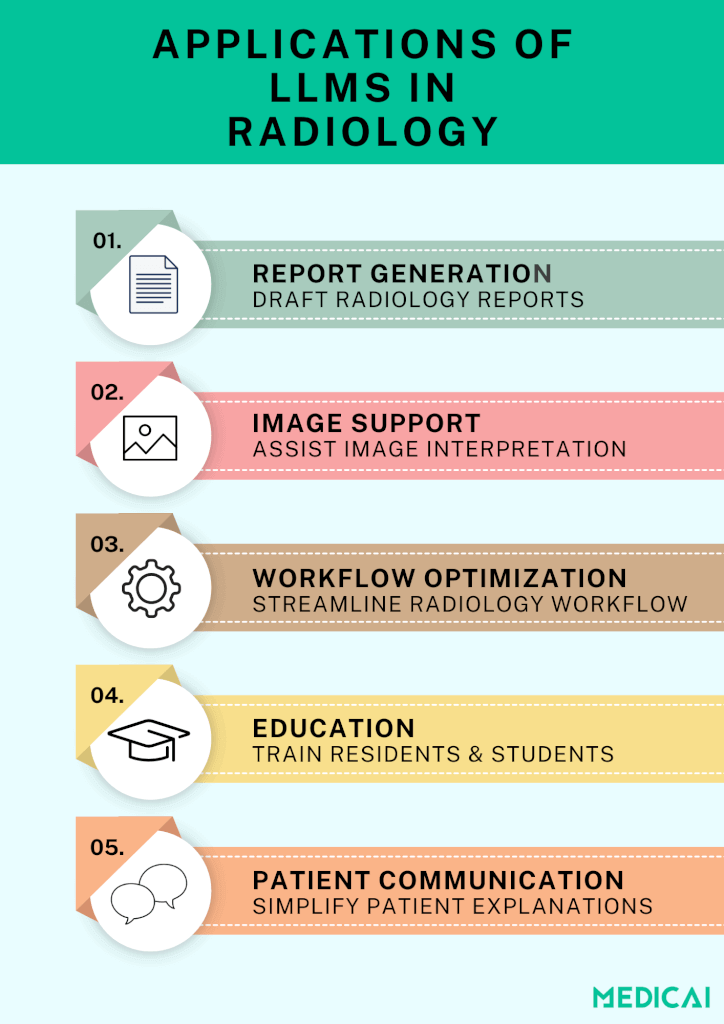
Let’s see the main areas where LLMs are beginning to make a difference.
Automated Report Generation
Radiology reports follow a structured format but can be time-consuming to write. LLMs can draft the first version of a report by analyzing imaging findings and converting them into clear, coherent text.
For example, after an AI vision model detects “left pleural effusion” on a chest X-ray, the LLM can expand that into a full impression paragraph.
The bonus is that the same report can be instantly rephrased into a patient-friendly version, written at a 7th-grade reading level.
It saves time, reduces burnout, and helps standardize reporting across hospitals.
Image Interpretation Support
While LLMs don’t directly “see” images, they can work alongside computer vision systems to provide diagnostic support.
- A vision model identifies key features in the scan.
- The LLM turns these features into meaningful language, sometimes even suggesting likely diagnoses.
For example, GPT-4 achieved around 83% accuracy on radiology board exam questions, showing its potential as a second opinion tool.
Workflow Optimization
Radiology departments often face high patient volumes and tight schedules. LLMs can:
- Triage cases by analyzing request forms and prioritizing urgent studies.
- Suggest the right imaging protocol based on clinical notes.
- Act as a natural language interface for PACS or RIS, letting radiologists type or speak queries.
Education & Training
LLMs can also serve as tutors for residents and medical students. They can:
- Explain complex imaging concepts in plain language.
- Quiz trainees with board-style questions.
- Simulate case scenarios, offering feedback like a knowledgeable colleague.
For overworked educators, this can be a valuable supplement to traditional teaching.
Patient Communication
A major issue in radiology is poor communication with patients. Reports are often written for doctors, not for patients. LLMs can bridge this gap by:
- Translating reports into plain, patient-friendly summaries.
- Answering common questions about imaging procedures.
- Offering reassurance and guidance while making it clear that AI is not a substitute for the physician.
Benefits of LLM Radiology
Find out the benefits LLM is bringing to radiology.
- Faster Reporting, Less Burnout: Radiologists typically spend hours dictating reports, but LLMs can draft them in seconds. It helps radiologists to focus more on complex cases instead of repetitive tasks.
- Standardization Across Reports: Radiologists often use varied wording for similar findings. LLMs help standardize terminology, enhancing clarity, reducing confusion, and facilitating easier data analysis for research and quality control.
- Better Collaboration and Second Opinions: An LLM acts as a digital colleague, providing diagnostic suggestions, follow-up recommendations, and identifying unusual patterns. It helps improve confidence and catch things that might be overlooked.
- Patient-Friendly Explanations: LLMs can rewrite a dense radiology report in plain language that patients actually understand. It enhances communication, fosters trust, and promotes patient engagement in their care.
- Speeding Up Research and Innovation: LLMs can analyze extensive medical literature, create summaries, and write code for imaging research. It speeds up discovery and helps scientists to focus on more complex questions.
Challenges and Risks of LLMs in Radiology
As exciting as large language models sound, they also come with serious caveats.
Accuracy and Hallucinations
LLMs sometimes “hallucinate”—that is, they confidently make things up. In radiology, this might mean inventing a finding that doesn’t exist in the scan.
Studies have shown general models like ChatGPT can hallucinate in more than half of their radiology summaries, while specialized models perform better but still make mistakes.
Bias in Training Data
Most training data comes from English-speaking, Western institutions. That means the models may not perform equally well for underrepresented groups or rare conditions. If unchecked, this bias could widen healthcare disparities instead of closing them.
Privacy and Security Risks
Training or fine-tuning on radiology reports carries the risk of exposing protected health information (PHI). Even de-identified data can sometimes be re-identified. Strict compliance with HIPAA, GDPR, and local privacy laws is essential before clinical use.
Medicai’s focus on compliance (HIPAA/GDPR) and secure cloud workflows provides the guardrails that LLMs need before clinical adoption.
Ethical and Legal Questions
Who is responsible if an AI-generated report is wrong—the model, the hospital, or the radiologist who signed it off?
For now, the burden of responsibility falls on radiologists. But as AI takes on more roles, liability will need clear rules. Regulators, such as the FDA in the U.S. and the EU AI Act in Europe, already classify medical LLMs as “high-risk.”
Financial and Environmental Costs
Training large models requires enormous computing power, sometimes equivalent to the energy use of a trans-Atlantic flight. That makes widespread adoption expensive and raises sustainability concerns.
Conclusion
Large language models are opening a new chapter in radiology, where AI doesn’t replace radiologists but amplifies their expertise. From faster reporting to clearer patient communication, LLMs promise efficiency and impact.
Yet, success depends on validation, oversight, and ethical use.
Platforms like Medicai bridge the gap, combining secure cloud PACS with AI-powered language tools. The result is improved workflows, empowered radiologists, and patients who understand their reports, leading to more patient-centered imaging.


Related Articles
Lets get in touch!
Learn more about how Medicai can help you strengthen your practice and improve your patients’ experience. Ready to start your Journey?
Book A Free Demo