

Caught in a personal injury battle? Your strongest evidence might already be on the screen.
Medical images—MRIs, CT scans, X-rays—aren’t just diagnostic tools anymore. They’re powerful legal assets that help prove injuries, clarify claims, and fast-track settlements.
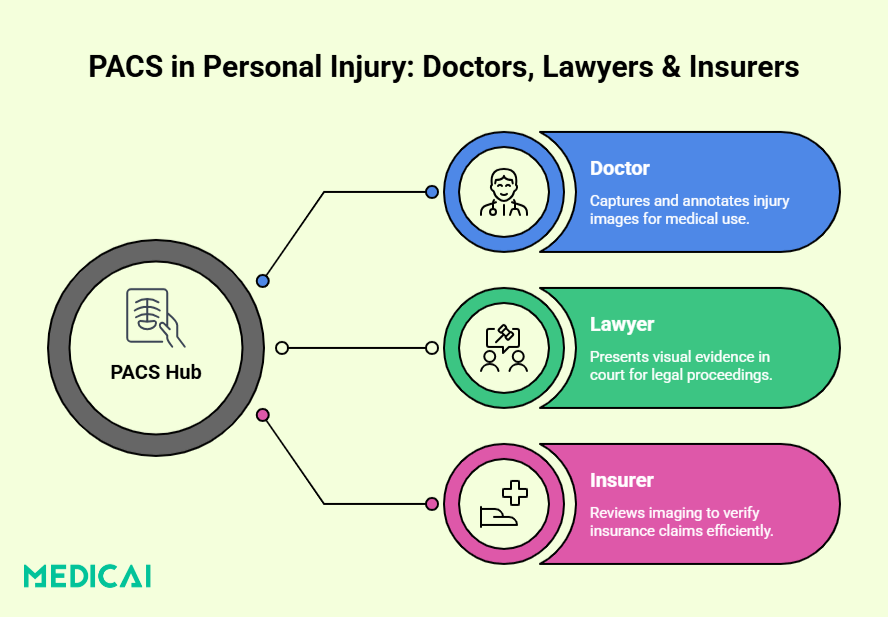
PACS (Picture Archiving and Communication System) is at the center of this transformation. This secure digital platform connects healthcare providers, lawyers, and insurers with real-time, high-quality imaging data.
Let’s discover how PACS streamlines communication, reduces delays, and strengthens personal injury cases from clinic to courtroom.

The Role of Medical Imaging in Personal Injury Law
Medical imaging is often indispensable in personal injury cases. Whether it’s an X-ray revealing a clean bone fracture, an MRI highlighting spinal disc herniation, or a CT scan detailing traumatic brain injuries, these diagnostic tools offer something no testimony can: objective, visual proof of harm.
Images show trauma in a format that’s easy to understand, even for those without a medical background. For example, a jury might struggle to grasp the extent of a back injury through words alone. But a clear side-by-side image of a misaligned vertebra before and after the accident?
That creates an immediate, undeniable impact.
For legal teams, these images support the narrative. Combined with medical reports, they confirm that the plaintiff’s injuries are real and consistent with the incident. This enhances credibility, strengthens expert testimony, and can impact settlement negotiations and courtroom verdicts.
Medical images are crucial in determining claim value, clarifying injury severity, long-term effects, and necessary treatment. Effective imaging can expedite negotiations, deter low settlement offers, and strengthen lawyers‘ advocacy for their clients.
PACS: The Backbone of Imaging Collaboration
When a patient gets an MRI after an accident, there’s no time to wait for CDs or printouts. With PACS (Picture Archiving and Communication System), the image is instantly stored and accessible on demand, in full resolution.
For injury cases, speed matters. Attorneys, doctors, and insurers can access the same image simultaneously from anywhere. There are no delays or duplication. And because PACS tracks every access and preserves image quality, it’s courtroom-ready and legally traceable.
DICOM: Imaging That’s Universally Understood
While PACS is the storage hub, DICOM is the universal format that makes medical imaging shareable and consistent. It includes patient information, timestamps, and technical data—all of which are critical in a legal review.
DICOM ensures that images are not only viewable but also interpretable across different systems—whether in a hospital, a law firm, or an insurance company. It also allows annotations, turning complex scans into clear, compelling legal exhibits.
HIPAA and Security Built-In
Legal access to medical data demands airtight security. PACS platforms are HIPAA-compliant by design, with encryption, access control, and full audit trails.
Advanced systems like Medicai go further: They set expiration links, assign role-based permissions, and log every interaction. Thus, providers, lawyers, and insurers can collaborate quickly without risking patient privacy.
Why Seamless Imaging Access Accelerates Settlements
One of the biggest frustrations in personal injury cases is waiting. Waiting for CDs to arrive, waiting for printed films, waiting for someone to locate that one missing scan from six months ago.
PACS eliminates all of it.
With instant, remote access to high-resolution medical images, legal and insurance teams can move fast.
Attorneys don’t have to postpone filings because they’re waiting on radiology records, and insurers don’t need to stall claims while requesting updated imaging from providers.
Everything is already there—in one centralized, secure system.
That speed translates into momentum. With fewer gaps and no back-and-forth chasing files, cases progress faster. Depositions are scheduled earlier, settlement talks start sooner, and justice moves forward on time.

Improving Accuracy and Transparency for All Parties
When everyone sees the same evidence, confusion disappears. Shared imaging access through PACS levels the playing field for doctors, lawyers, and insurers.
- Radiologists can annotate findings directly on the scan.
- Lawyers can use those annotations to support legal arguments.
- Insurers can verify those same findings against claim details.
No duplication. No misinterpretation. No finger-pointing.
This transparency minimizes disputes about injury severity, timing, or causation, fostering stakeholder trust and enhancing expert testimony for fair outcomes. It leads to fewer surprises in court and reduces last-minute delays, as all parties work from the same images, allowing for more effective resolution.
Medical Specialists: The Frontline of Injury Documentation
Every personal injury case starts at the clinic. The first step is imaging whether a surgeon examines a torn ligament, a chiropractor treats whiplash, or a podiatrist evaluates a fractured ankle. Every scan, every report, and every annotation enters the legal pipeline through PACS.
Here’s how it works: a patient visits a chiropractor with back pain following a car accident. The chiropractor orders X-rays, which are uploaded directly to the PACS platform—no CDs, emails, or delays. The images are tagged with patient info, date, and scan type in DICOM format so that any authorized party can access them later.
In a different scenario, a podiatrist captures CT images of a foot injury caused by a workplace accident. Those images, too, are stored in PACS, where they become part of a continuous injury record that attorneys, specialists, or insurers can access.
Whether clinical or legal, each provider can build on the last, ensuring a complete and chronological medical narrative.
Multispecialty Collaboration via PACS
Personal injury cases often require input from multiple providers.
For example, a single car accident might involve an ER physician, a spinal surgeon, a physical therapist, and a neurologist. Without a shared system, communication can break down between them.
PACS enhances care by allowing specialists to access and collaborate on existing images, reducing documentation errors. It also enables real-time consultations, letting a radiologist guide a neurosurgeon remotely using the same scan.
This kind of collaboration strengthens both the medical treatment and the legal argument. It ensures consistent opinions, avoids miscommunication, and helps attorneys build a unified, evidence-based case narrative backed by multiple expert viewpoints.

Legal Professionals: Turning Images into Winning Evidence
Imagine walking a jury through a plaintiff’s spinal disc herniation. You could describe it in medical terms. Or you could show them a high-resolution MRI with the injury clearly outlined. One method might be forgotten. The other stays burned into memory.
That’s where PACS becomes a legal tool, not just a medical one.
Attorneys can remotely access high-quality diagnostic images alongside corresponding radiology reports. Features like zoom and annotations allow lawyers to highlight specific trauma moments and locations, enhancing the precision and credibility of their arguments.
Images also help during expert witness testimony. When a doctor explains an injury using the same scan the jury sees, it adds weight and trust to their words.
Legal-Specific Viewers and Presentation Tools
Today’s PACS platforms—especially those designed for legal use, like Medicai—go far beyond storage. They come with viewer tools built specifically for litigation prep.
- Highlight key findings using arrows, circles, or overlays
- Compare images side by side (e.g., pre- and post-accident scans)
- Add time-stamped annotations to show injury progression
- Zoom in on microfractures or tissue damage for better visibility
- Export curated image sets for expert review or court presentation
These features address real legal challenges. Lawyers can present evidence in a clinical format, ensuring full accuracy instead of relying on vague reports or PowerPoint.
With HIPAA-compliant cloud platforms like Medicai, legal teams collaborate seamlessly with medical experts, viewing the same images and tools. This makes case preparation faster, smoother, and more defensible.
Insurance Companies: Making Smarter Decisions with Imaging
For insurers, reviewing medical records is crucial. Incomplete files or vague notes slow processes and create uncertainty. PACS platforms provide secure, read-only access to diagnostic images and reports, streamlining claim validation.
HIPAA-compliant viewers like Medicai allow adjusters to assess conditions such as torn tendons or internal bleeding clearly.
PACS platforms also offer granular access controls, allowing legal teams or healthcare providers to restrict insurers’ views to specific conditions and time frames. This ensures patient privacy while maintaining regulatory compliance.
Integration with Claims Platforms
Using APIs (Application Programming Interfaces), platforms like Medicai can link directly to insurance tools, so relevant diagnostic images and medical reports automatically populate a case file. There is no need for repeated data entry or manual uploads.
This integration delivers real value:
- Faster claims decisions because adjusters can instantly access high-quality evidence
- Lower costs by reducing repeat scans or unnecessary appointments
- More accurate evaluations, with complete visual context of the injury
- Streamlined communication across providers, attorneys, and insurers
Equipped with objective, high-resolution evidence from trusted sources, insurers are more likely to assess harm and approve fair compensation for injured parties accurately.
The Personal Injury Data Flow Model: From Clinic to Courtroom
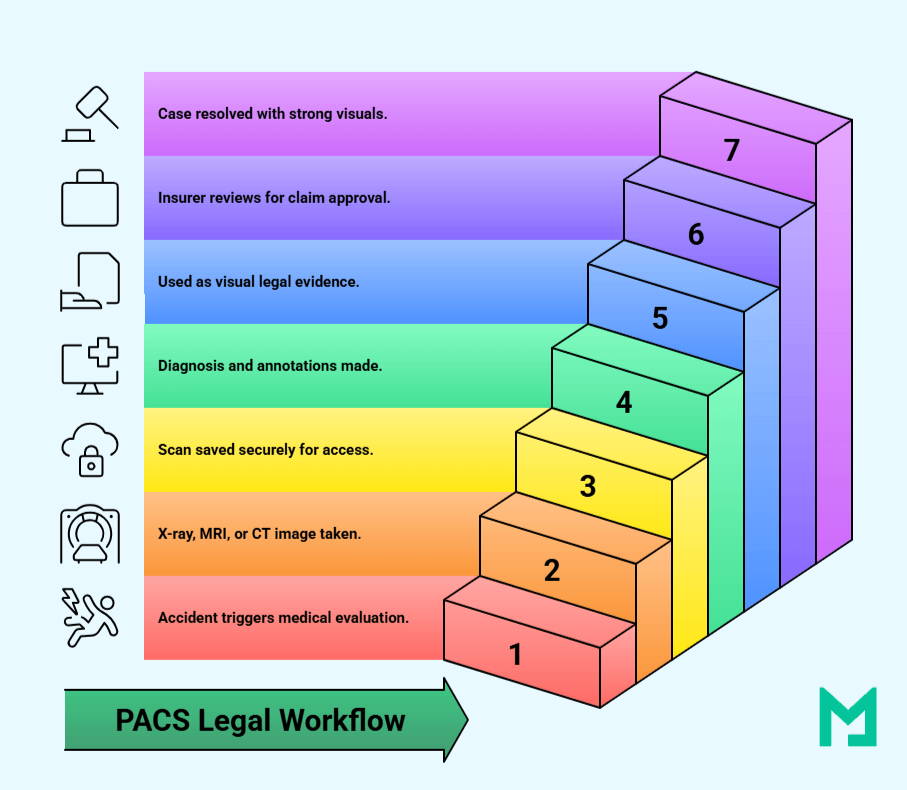
Behind every successful personal injury claim is a quietly and efficiently working system. That system is PACS. It connects healthcare providers, legal teams, and insurers in one continuous loop of data, evidence, and action.
Let’s see how the flow typically works:
- Injury Occurs: The patient visits a healthcare provider—ER, chiropractor, podiatrist, or orthopedic specialist.
- Imaging Is Captured and uploaded to PACS: CT scans, MRIs, or X-rays are taken and instantly stored in a PACS system with full DICOM metadata.
- Reports Are Generated: Radiologists review and annotate images. Structured reports are added to the patient record.
- Legal Teams Gain Secure Access: Attorneys use PACS-integrated viewers (like Medicai) to review and select images relevant to the case. These are used in depositions, expert testimony, and settlement negotiations.
- Insurers Review Medical Imaging: With permission-based access, insurance adjusters and medical directors evaluate the same imagery to validate claims and calculate compensation.
- Case Progresses with Shared Visual Evidence: Everyone from surgeons to claims specialists is looking at the same source of truth, reducing errors and miscommunication.
- Settlement or Verdict: With consistent, objective, well-documented medical evidence, resolution becomes faster and more accurate.
This model reduces friction. No chasing down film copies. No mismatched files. Just one secure, centralized system where everyone sees the same story, the same way.
Conclusion
In personal injury cases, timing, clarity, and collaboration make all the difference, and PACS delivers on all three. By turning medical images into accessible, high-quality evidence, PACS bridges the gap between healthcare, law, and insurance. It streamlines workflows, speeds up settlements, and ensures every stakeholder sees the same story, the same way.
As imaging tech evolves, systems like Medicai set the new standard for efficiency and trust. For legal teams, this isn’t just progress, it’s power in practice.


