VNA Radiology: The Future of Medical Image Archives

Have you ever wondered why sharing medical images across hospitals is often frustrating and slow?
A Vendor-Neutral Archive (VNA), also known as VNA radiology, is the solution.
VNA stores imaging data in standardized formats, making it accessible across PACS, EHRs, and departments. In radiology, VNAs remove vendor lock-in, simplify data migration, and ensure every clinician has access to a complete imaging record.
Discover how VNAs work, their benefits, and why they’re becoming the backbone of modern radiology.
What is a VNA (Vendor-Neutral Archive)?
A Vendor-Neutral Archive (VNA) is a medical imaging solution that stores, manages, and shares clinical images independently of any single vendor. Unlike traditional PACS, which often restrict data access to specific systems, a VNA ensures images are available across various platforms and specialties through standardized formats and interfaces.
This means radiology departments, cardiology units, pathology labs, and even referring physicians can all access the same image data without worrying about compatibility issues.
In simple terms, a VNA is the universal library of medical imaging, future-proof, vendor-agnostic, and built for long-term clinical collaboration.

Core Principles and Components of a VNA
Discover the core components of a VNA radiology.
DICOM Standardization
The foundation of any VNA is DICOM (Digital Imaging and Communications in Medicine). VNAs ensure that all imaging data, from CT and MRI to ultrasound and X-ray, are stored in a DICOM-compliant format.
This universal standard allows seamless sharing and interpretation, regardless of which scanner or PACS generated the image.
Tag Morphing / Normalization
Different vendors often use slightly different metadata “tags” to describe images. A VNA applies tag morphing or normalization, which harmonizes these variations into a consistent format.
The process ensures that patient demographics, study descriptions, and imaging details remain accurate and searchable across all systems.
Storage Abstraction (Modality Decoupling)
A VNA separates image storage from the imaging modality or PACS. Instead of tying storage directly to the scanner or viewing system, images are archived in a neutral, centralized repository. This decoupling prevents vendor lock-in and makes future migrations far less disruptive.
Interfacing with PACS, RIS, HIS, and EHR
VNAs act as a bridge between systems. They integrate with:
- PACS (for viewing and workflows)
- RIS (Radiology Information System)
- HIS (Hospital Information System)
- EHR (Electronic Health Record)
This integration ensures that imaging data becomes part of a unified patient record, accessible within the broader clinical context.
Support for Non-DICOM Content
Modern medicine generates more than just DICOM images. VNAs can also store and manage non-DICOM content such as scanned reports, pathology slides, waveforms (e.g., ECG), and even video files from endoscopy. This makes the archive truly enterprise-wide, not just radiology-centric.

Identity and Patient Resolution Across Domains
Hospitals and health systems often face the challenge of duplicate or mismatched patient records across departments.
VNAs support identity resolution, linking all imaging studies to the correct patient profile, even across multiple facilities or EHR systems. This reduces errors and creates a single, longitudinal imaging record for every patient.
How a VNA Works?
A Vendor-Neutral Archive connects medical imaging sources, clinical systems, and users through standardized processes.
Step 1: Image Capture and Ingestion
- When an imaging study is performed, the scanner or PACS sends the data to the VNA.
- The VNA ingests images in DICOM format, while also accepting non-DICOM objects such as PDFs, waveforms, or pathology slides.
- At this stage, the VNA validates the file format and ensures the study is complete before archiving.
Step 2: Metadata Normalization
- Each imaging study comes with metadata (patient name, ID, modality, body part, date).
- Because different vendors label fields differently, the VNA applies tag morphing and normalization.
- This harmonization guarantees that a CT from Vendor A and an MRI from Vendor B can be stored and retrieved consistently under the same patient record.
Step 3: Secure Storage
The validated and normalized studies are stored in the VNA’s tiered storage architecture:
- Hot storage: For recent or frequently accessed exams.
- Warm storage: For moderately accessed studies.
- Cold/archive storage: For long-term retention and compliance.
Data is encrypted, indexed, and protected with redundancy to avoid loss.
Step 4: Indexing and Cataloging
The VNA builds an index of all stored objects, making them searchable by patient ID, modality, date, or study type. This index is what enables fast retrieval, even across millions of stored images.
Step 5: Routing and Access
- When a clinician requests a study (through PACS, RIS, EHR, or web viewer), the VNA routes the right file from the correct storage tier.
- Caching and prefetching help reduce delays for commonly used or recently accessed studies.
- Access control ensures that only authorized users can retrieve sensitive data.
Step 6: Retrieval and Display
The requested study is delivered via DICOM, DICOM-Web, or IHE profiles, ensuring compatibility with various viewing systems. Radiologists can use their preferred PACS or viewer, while the VNA ensures they all get the same standardized, verified data.
Step 7: Enterprise and Cross-System Sharing
Beyond radiology, the VNA allows images to flow into cardiology, pathology, dermatology, or any clinical department. Using IHE XDS-I or FHIR standards, images can also be shared across facilities, enabling enterprise imaging strategies or even regional/national image networks.
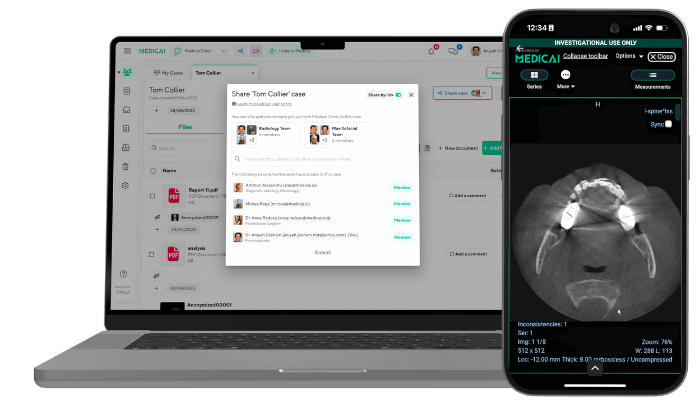
Solutions like Medicai leverage IHE and FHIR standards to simplify secure image exchange between departments and even across hospitals.

PACS vs VNA
Although PACS and VNA both deal with medical imaging, they serve very different purposes. Understanding the distinction is crucial for hospitals and health systems planning their enterprise imaging strategy.
Advanced platforms such as Medicai bridge PACS, RIS, HIS, and EHR seamlessly, turning the VNA into a true enterprise imaging backbone.
PACS: Workflow-Focused Imaging
- Manages the capture, storage, and display of radiology images.
- Built around radiology workflows like reading, reporting, and scheduling.
- Tightly linked to specific vendor systems and often department-focused.
- Optimized for speed and daily use, not long-term storage.
VNA: Archive and Interoperability Backbone
- Serves as a central, long-term repository for imaging data.
- Stores images in standardized formats (DICOM, non-DICOM).
- Provides vendor independence and integration across PACS, RIS, HIS, and EHR.
- Designed for enterprise-wide access and future-proofing.
| Feature | PACS | VNA |
| Primary Purpose | Workflow and image viewing | Long-term storage and interoperability |
| Scope | Department-specific (radiology, cardiology) | Enterprise-wide (all specialties, cross-site) |
| Data Type | Mostly DICOM | DICOM + non-DICOM (PDFs, ECGs, pathology, video) |
| Vendor Lock-In | High (tied to one vendor ecosystem) | Low (vendor-independent, open standards) |
| Migration | Complex and costly | Simplified, future-ready |
| Integration | Limited to the PACS ecosystem | Works with PACS, RIS, HIS, EHR |
| User Base | Radiologists and imaging staff | Radiologists, clinicians, IT, and multi-departmental |
| Retention | Short- to mid-term (active workflow) | Long-term (lifetime patient record) |
Benefits of VNA in Radiology
Adopting a Vendor-Neutral Archive (VNA) in radiology transforms the storage, access, and sharing of imaging data across the healthcare enterprise.
Vendor Independence
Traditional PACS often lock organizations into one vendor’s ecosystem, making upgrades or replacements costly. A VNA eliminates this risk by storing data in open, standardized formats.
Hospitals retain full control of their archives, regardless of which PACS or viewer they use in the future.
Enterprise-Wide Interoperability
A VNA connects radiology with other departments, including cardiology, pathology, dermatology, and more. Supporting DICOM and non-DICOM content, it creates a unified patient imaging record that can be accessed across the entire healthcare system.
Streamlined Data Migration
Migrating from one PACS to another is notoriously complex. With a VNA in place, data migration becomes simpler. Historical imaging data remains safely archived, while new systems can be integrated without major disruptions.
Long-Term Archiving & Compliance
VNAs are designed for durable, long-term storage. With lifecycle management features, images are automatically moved to hot, warm, or cold storage tiers as needed. It ensures compliance with regulatory requirements (such as HIPAA and GDPR) while keeping costs under control.
Cost Efficiency
By centralizing storage and reducing duplication, a VNA lowers infrastructure costs over time. Hospitals avoid expensive vendor-specific upgrades and optimize storage by using tiered archiving strategies.
Enhanced Clinical Collaboration
Radiologists, referring physicians, and specialists can all access the same imaging record through the VNA. It improves collaboration, speeds up decision-making, and enhances patient care by ensuring every clinician works from the same data.
Future-Proofing for Innovation
VNAs are designed to handle evolving technologies, including cloud storage, AI-driven analytics, and new imaging modalities such as digital pathology. This makes them a long-term investment that grows with the healthcare enterprise.
Use Cases in Radiology & Enterprise Imaging
A Vendor-Neutral Archive (VNA) supports a wide range of clinical and operational needs, making it a cornerstone of enterprise imaging.
- Radiology Department Consolidation: VNAs centralize imaging across multiple hospitals or sites, giving radiologists a single patient record and reducing storage duplication. It improves efficiency and ensures continuity of care.
- Cross-Department Imaging: Beyond radiology, departments like cardiology, pathology, and endoscopy also generate images. VNAs store DICOM and non-DICOM formats, creating a unified imaging record accessible to all clinicians.
- Teleradiology & Image Sharing: With standardized protocols, VNAs enable secure image sharing across facilities. This supports teleradiology, remote consultations, and even regional or national archives for broader healthcare networks.
- Disaster Recovery & Retention: VNAs protect data through replication, backups, and tiered storage. They ensure long-term retention, compliance with HIPAA/GDPR, and resilience during outages or disasters.
- AI & Analytics: AI thrives on large, clean datasets. VNAs provide centralized, normalized archives that fuel machine learning, research, and advanced diagnostics while keeping data accessible across systems.
Top VNA Solutions in Radiology
Several key platforms in medical imaging offer robust features, scalability, and seamless integration with healthcare IT systems. Here are the top VNAs to know.
Medicai VNA
Medicai VNA offers a standards-based, cloud-ready archive built for interoperability. Supporting multiple formats and DICOM standards, it enables healthcare providers to share imaging data across departments, facilities, and even regions.
Its vendor-neutral design, AI-readiness, and cost efficiency make it a forward-looking choice for providers aiming to future-proof their imaging strategies.
Sectra VNA
Sectra VNA provides a unified platform for managing medical images across modalities and vendors. With scalable storage, advanced redundancy, and strong security, it’s designed to support enterprise-wide imaging.
Its intuitive interface and workflow tools make it a trusted choice for large hospital networks.
GE Healthcare Centricity Clinical Archive
GE Healthcare’s Centricity Clinical Archive is a complete solution for organizing and sharing images and documents. It helps manage data effectively, works well with various systems, and seamlessly integrates into existing healthcare setups.
Philips IntelliSpace PACS VNA
Philips IntelliSpace is a tool that combines imaging management with PACS and VNA functions. It simplifies how healthcare organizations handle images and improves teamwork and workflow.
The system offers advanced analytics, easy data transfer tools, and a flexible design, which helps organizations monitor performance and enhance quality initiatives.
Fujifilm Synapse VNA
Fujifilm Synapse VNA supports both DICOM and non-DICOM content, offering flexibility for diverse imaging needs. Its comprehensive management features, seamless IT integration, and user-friendly design make it ideal for organizations consolidating imaging across departments.
Conclusion
A Vendor-Neutral Archive (VNA) goes beyond storage; it centralizes radiology data, enhances interoperability, and ensures long-term accessibility. It enables clinicians to provide faster, smarter care and prepares hospitals for innovations like AI, analytics, and cloud integration.
Solutions like Medicai’s imaging platform bring these benefits to life, combining interoperability with security and scalability.


Related Articles
Lets get in touch!
Learn more about how Medicai can help you strengthen your practice and improve your patients’ experience. Ready to start your Journey?
Book A Free Demo