Why is Teleradiology the Future Of Modern Imaging?

What if your doctor could access a specialized radiologist in no time, no matter where you live?
Well, teleradiology answers your question.
Teleradiology significantly benefits both healthcare providers and patients. Using advanced technology, radiologists can now examine medical images from anywhere. This change leads to faster and easier access to high-quality healthcare.
Stay with me to find all the benefits of teleradiology services that reshape healthcare systems.

7 Super Teleradiology Benefits
Teleradiology has changed the game for medical imaging.
It’s faster, easier to get to, and more efficient than it used to be. Patients, doctors, and radiologists can now connect in ways that seemed impossible a while ago.
Do you want to know how teleradiology is helping healthcare providers and patients? Read along.
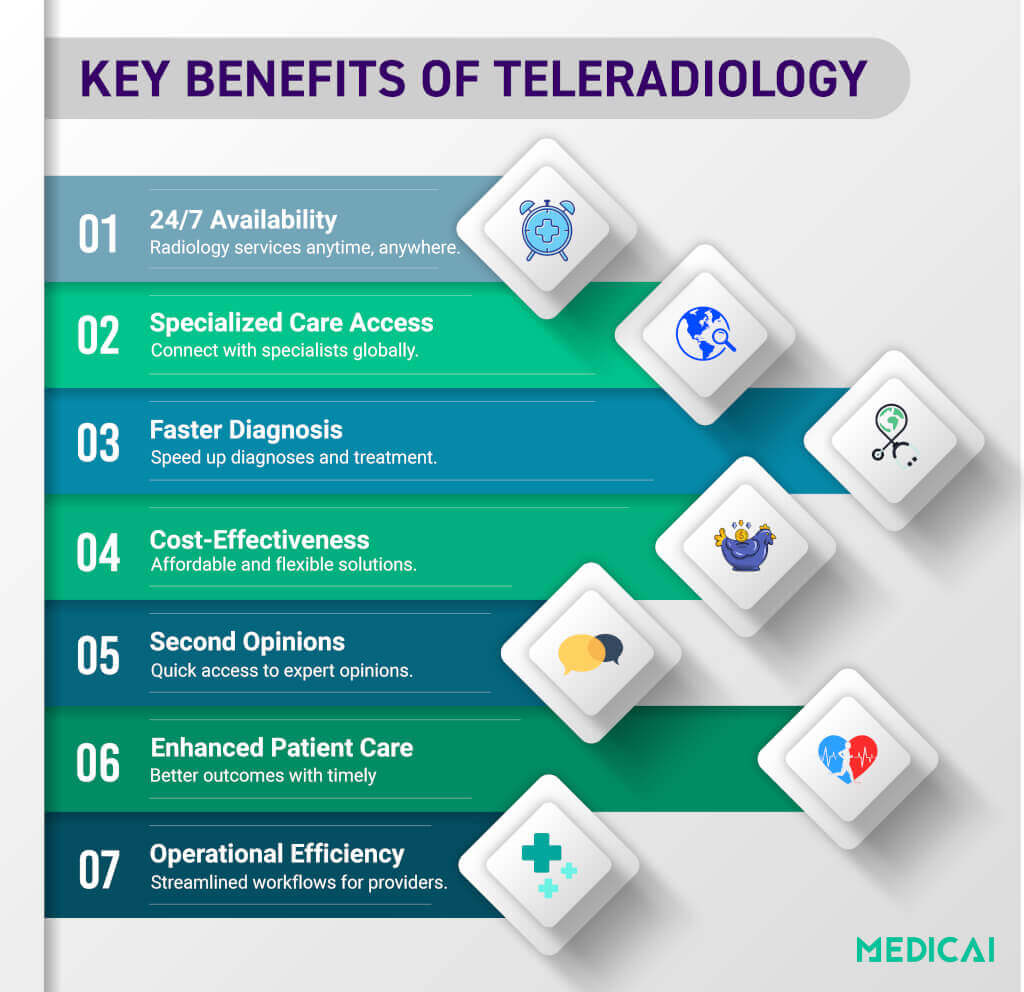
24/7 Availability
Illness and emergencies don’t see the schedule.
They just invade when desired. And radiologists may not always be available. However, teleradiology always ensures that you get the radiology service anytime.
Teleradiology makes it super easy to get imaging studies read, whether it’s the dead of night or a holiday. This means that radiology services are always ready and available whenever needed.
Teleradiology is especially beneficial for smaller or rural healthcare facilities. Clinics that don’t have on-site radiologists during off-hours can still offer uninterrupted care. They can send images taken at night to on-call teleradiologists and get the report by morning.
On the other hand, large hospitals can use teleradiology as a backup for overburdened teams.
Access To Specialized Care
Finding a specialized radiologist in many rural or underserved areas is challenging. Patients often drive far just to get the care they need.
Can you guess the worst part? They frequently end up with treatment that doesn’t suit their needs or expectations.
However, teleradiology has changed access to specialized care. Now, healthcare providers can easily link up with specialized radiologists, even if they’re far away.
With teleradiology, doctors at smaller clinics can easily send a patient’s scan to a specialized radiologist in a big city. The results can be returned in just a few hours, allowing patients to get the necessary care.
Another considerable benefit of teleradiology is that it has broken global barriers. Hospitals in one country can collaborate with experts in another country and gain world-class diagnostic insights.
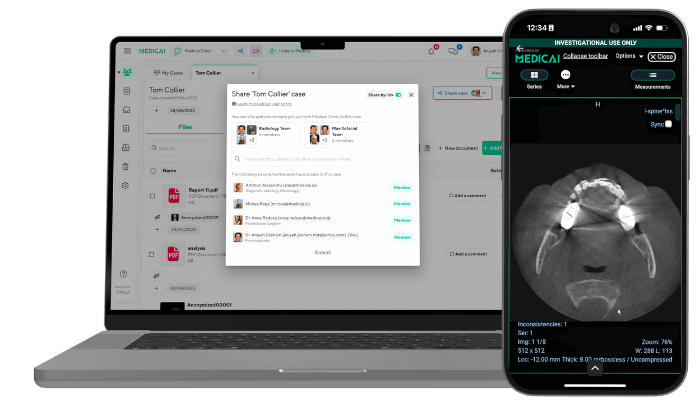
Medicai links healthcare providers with a network of radiologists, ensuring patients can get top-notch teleradiology care whenever needed.
Faster Diagnosis and Treatment
A patient arrives at the ER showing signs of a stroke at off-hours, and you don’t have any radiologist for interpretation, delaying the diagnosis and treatment. The thought is indeed scary.
However, teleradiology magically solves this issue. Doctors can upload medical imaging directly to a platform where a teleradiologist is ready to review it instead of waiting for the radiologist.
Within minutes, the radiologist can interpret the images and send their reports so the care team can start the treatment instantly. Isn’t it cool!
Not only emergencies but everyday delays, such as waiting for files to transfer, tracking down specialists, etc., are no longer significant issues with teleradiology. It ensures patients get answers faster and move forward with a treatment plan sooner.
Medicai’s platform is built for speed. It provides seamless data sharing and prioritizes urgent cases, helping providers and radiologists to work efficiently.
Cost-Effectiveness
Healthcare can be expensive.
Smaller clinics and hospitals often struggle to balance their budgets to hire a full-time in-house radiologist. However, teleradiology significantly reduces their burden by offering a flexible, affordable solution.
Now, a small clinic can use teleradiology to get expert interpretations instead of hiring a full-time radiologist. They can access radiology services on demand, paying only for their needs.
Teleradiology also saves money on infrastructure. Traditional teleradiology needs physical storage for imaging studies, which can be costly. However, with cloud-based platforms like Medicai, their costs disappear.
These platforms offer cost-effective solutions with scalable service and storage that save clinicians money without sacrificing quality.
Access To Second Opinions
A second opinion can make a huge difference when a diagnosis is complex or uncertain. Teleradiology connects healthcare providers to subspecialists who can review challenging cases to provide additional insights.
Radiologists, physicians, and specialists can collaborate through teleradiology platforms to review the studies together. Their efficient teamwork results in a holistic approach to patient care.
In short, teleradiology enhanced collaboration, teamwork, accuracy, and a confident treatment plan.
Enhanced Patient Care
Teleradiology doesn’t just make healthcare faster; it makes it better.
Quick and accurate diagnoses help patients. Early detection lets doctors intervene before conditions worsen, improving recovery rates. For those with chronic conditions, regular access to imaging can keep their care on track and effective.
Teleradiology also offers patients convenience.
They don’t need to travel far to larger hospitals for advanced imaging or wait days for results.
Patients can stay at home and still receive expert care, knowing their doctor has access to top-tier radiologists. This reduces anxiety and boosts peace of mind during stressful diagnoses.
Operational Efficiency
Running a hospital or clinic is no small task. Teleradiology makes it much easier by streamlining workflows and balancing workloads.
Radiologists can work remotely and review cases from multiple facilities. This reduces burnout and ensures that every study receives the attention it deserves.
Besides, automation takes the workflows a step ahead. AI-powered tools integrated into teleradiology platforms can prioritize urgent cases, generate preliminary findings, and help radiologists focus on complex diagnoses.
Thus, teleradiology provides faster turnaround times and more accurate reports for patients.
AI-driven platforms like Medicai can immensely enhance healthcare workflows with advanced technologies and seamless data sharing. We guarantee you will work smarter, not harder, to stay ahead of your healthcare team.
Supporting Technologies Enhancing Teleradiology Benefits
Teleradiology wouldn’t be the transformative tool it is today without the powerful technologies driving it. Let’s discover how technological innovations make teleradiology possible.

Cloud-Based Platforms
Imagine a secure digital space where radiologists, physicians, and healthcare teams can access, share, and review imaging studies anytime, anywhere.
Well, that’s the power of cloud-based platforms.
Scalability
Cloud-based platforms provide flexible, scalable, and secure storage solutions for imaging files such as MRIs, CT scans, and ultrasounds. They ensure that healthcare providers can scale their operations as patient volumes grow.
A cloud platform can easily adapt to a small clinic that suddenly sees a surge in imaging needs without costly hardware upgrades.
This scalability means healthcare facilities of all sizes—from local clinics to large hospitals—can deliver consistent and efficient radiology services without worrying about storage limitations.
Security
Medical imaging files contain sensitive patient information, so keeping the data safe is a top priority. Cloud-based platforms provide unmatched security for healthcare.
Advanced encryption safeguards patient information during storage and transmission. It ensures compliance with global regulations like HIPAA and GDPR. Secure user access protocols and audit trails further protect sensitive data.
Medicai’s cloud-based platform combines scalability with top-notch security. The strong security provides healthcare providers and patients peace of mind.
AI Integration
Artificial intelligence is the new wonder that transforms teleradiology enormously.
Automated Workflows
AI is changing how we process and prioritize imaging studies. It can analyze data in real time to find urgent cases, like potential fractures or internal bleeding. When AI identifies these critical cases, it flags them for immediate review.
This helps ensure that the most critical cases get attention first, reducing patient care delays.
Advanced Analytics and Accurate Diagnoses:
AI provides radiologists with an additional layer of support. Machine learning algorithms can examine thousands of imaging scans and spot tiny details or issues a human might overlook during the first check.
This precision point enhances the accuracy of diagnoses, especially when dealing with tricky or uncommon cases.
Streamlined Reporting And Reduced Workload
AI tools also assist in generating preliminary reports. It reduces the administrative burden on radiologists.
With automated insights and data analysis, radiologists can focus their expertise on more complex cases.
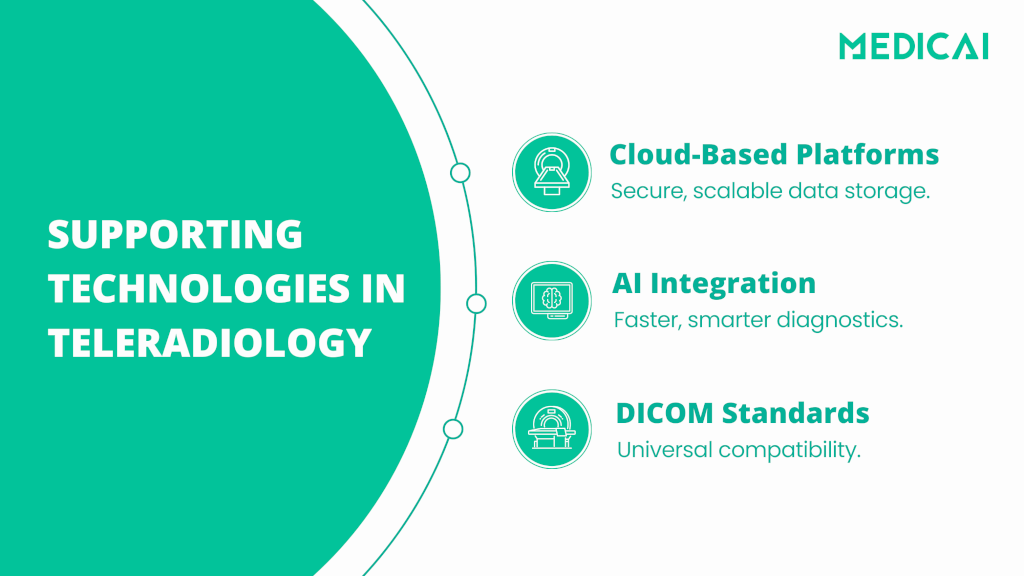
DICOM Standards
Medical imaging uses different machines and systems, and without some common communication rules, they couldn’t work together. That’s where DICOM (Digital Imaging and Communications in Medicine) comes in handy.

Consistency
DICOM standards enable the sharing and interpreting of medical images from various devices, like MRI and CT scanners, without compatibility issues. This standardization allows imaging data to be uniformly stored, transmitted, and displayed.
The compatibility helps radiologists concentrate on diagnoses instead of technical difficulties.
Collaboration Between Providers
DICOM standards help teleradiology collaboration considerably. It ensures that imaging data can be shared across platforms, devices, and geographical locations.
Whether it’s a second opinion from a specialist or a multidisciplinary team reviewing a case together, DICOM ensures everyone is on the same page.
Interoperability
The DICOM standard facilitates seamless integration between imaging devices, PACS (Picture Archiving and Communication Systems), and teleradiology platforms. It creates a connected ecosystem that supports efficient workflows – a smooth flow of images from acquisition to diagnosis.
Medicai is built on DICOM compliance, providing integration with existing imaging systems effortlessly.
Teleradiology Challenges
Several challenges you may face with teleradiology services that you can address quickly.
Connectivity Issues
Reliable internet is vital for teleradiology. However, many facilities, especially in rural locations, need more bandwidth. So, large imaging files like MRIs can delay uploads and diagnoses.
However, data compression, cloud caching, and emerging 5G networks can help maintain efficient workflows.
Image Quality
Radiologists need high-resolution images to make accurate diagnoses. However, file compression can risk image quality.
Facilities can use lossless compression, which preserves diagnostic integrity while optimizing files. Moreover, DICOM standards provide consistent formatting across systems.
Data Security
Medical imaging files are often an alluring target for breaches. Encryption, multi-factor authentication, and compliance with HIPAA and GDPR can safeguard patient data during storage and sharing.
Final Words
Teleradiology has changed healthcare magically by improving access, speeding up diagnoses, and enhancing patient care. It bridges the gap in expertise and geography and guarantees efficient and accurate radiology services for everyone.
With Medicai, teleradiology benefits intensify a thousand times. We provide secure, seamless, scalable solutions that enhance healthcare workflows and patient care.


Related Articles
Lets get in touch!
Learn more about how Medicai can help you strengthen your practice and improve your patients’ experience. Ready to start your Journey?
Book A Free Demo